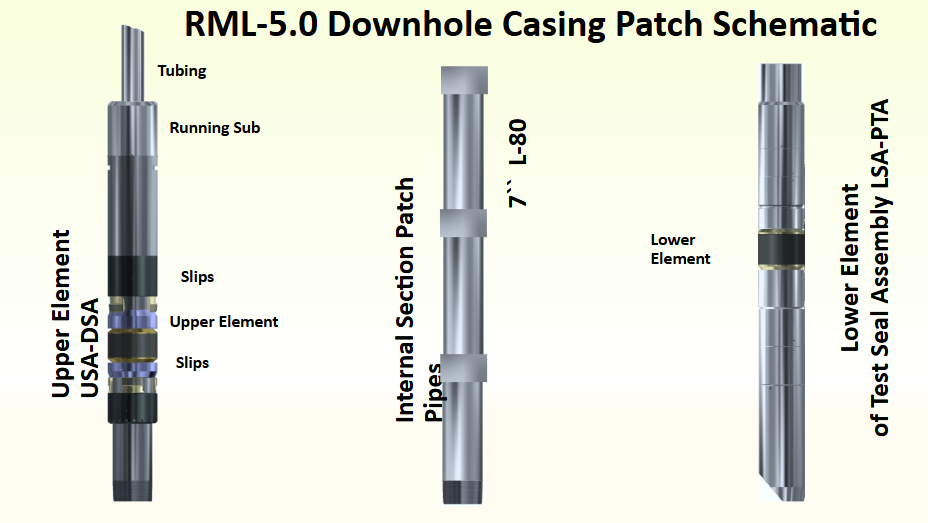
RML-5.0 Downhole Casing Patch
Customer needs a result! Revelation Management is pleased to introduce the new RML-5.0 Downhole Casing Patch.
Casing integrity challenges demand solutions that endure harsh conditions and minimize downtime. The RML-5.0 Downhole Casing Patch restores casing integrity without the risk of premature seal setting during installation, regardless of well conditions. Its unique design provides large internal diameter access for Enhanced Oil Recovery (EOR) operations with exceptional results.
This solution is also more cost-effective than cementing operations and demonstrates a high success rate, offering a reliable and efficient remedial solution for casing integrity issues in oil and gas wells.
100% Sealing Success
Across more than 200 operations worldwide
Lower Total Cost
A fraction of the cost of expandable patch systems
Thermal Ready
Element rating of 343°C (650°F) for thermal wells
RML-5.0 Downhole Casing Patch Advantages
- Casing leak repair with minimal downtime.
- Considering that casing failures may recur during oil well operation, the RML-5.0 Casing Patch may be retrieved when required and run in hole again at a deeper depth.
- Can be run in hole as a full assembly with a conventional rig.
- Double element seal to the wellbore while maintaining a large ID.
- Permits pumping of fluids during the run and setting of the patch elements.
- No requirement for a dog collar to support the patch while the inner string is run, by utilizing a C-plate.
- Can be pressure tested with inflate packers.
- High resistance of the patch to internal and external pressure.
- The Mule Shoe guide of the patch is designed to minimize the risk of snagging during RIH operations.
- Can be extracted from the well when required, with minimal issues and cost.
Product Specifications
- Easy to install, user friendly, minimal retraining.
- Multiple sizes: 7”, 9 5/8” and more.
- Pressure rating: tested to a pressure of 2,030 psi (14 MPa).
- Thermal rating: suitable for high temperature thermal wells, max 650°F (343°C).
- Product composition:
- AISI 4130 HTSR / L-80 (80 KSI Min Yield)
- AISI 4140 HTSR / P-110 (110 KSI Min Yield)
- AISI 1018 Mild Steel (50 KSI Min Yield)
- AISI 1026 Mild Steel (50 KSI Min Yield)
- AISI 8620
- High temperature element packing
RML-5.0 Technical Features
- Utilizes only a hydraulic setting tool to set the seals — no mechanical manipulation required.
- By design, the Casing Patch seals cannot be accidentally set under any circumstances.
- Tested to 22.2 daN (50,000 lb) downward force with zero force applied to the elements.
- Dressed for thermal applications with a seal rating of 343°C (650°F).
- ID of 160.9 mm (6.336”) on the 177.8 mm x 244.5 mm (7” x 9 5/8”) Casing Patch.
- Half-muled and beveled lower entry guide.
- Allows the client to maintain pumping of fluids during RIH and setting of the Casing Patch.
Solution #1 — RML-5.0 Recommended Procedure
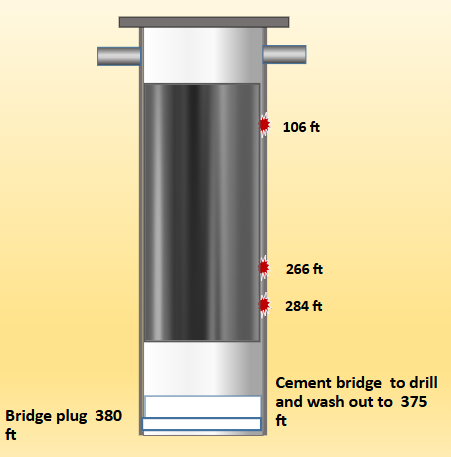
- Drill cement bridge to 375 ft.
- Run scraper and wash out to 375 ft.
- RIH with the RML-5.0 Casing Patch to confirmed depth. Set upper element and lower element.
- Pressure test the RML-5.0 Casing Patch.
- Pressure test the well.
- Drill out the cement bridge and bridge plug (an expandable bit is recommended to ensure a larger OD of the well).
Solution Comparison
Solution #2 — Single Expandable Patch: Disadvantages
- High cost — $125,000 to $150,000 USD.
- Low collapse resistance of the expandable patch under external pressure.
- High risk of snagging the upper and lower edges of the casing, leading to damage and subsequent loss of integrity.
- High cost and complexity of retrieval.
Solution #3 — Two Expandable Patches: Disadvantages
- High cost — $215,000 to $235,000 USD.
- Low collapse resistance of the expandable patches under external pressure.
- High risk of snagging the upper and lower edges of the casing, leading to damage and subsequent loss of integrity.
- High cost and complexity of retrieval.
Why Solution #1 (RML-5.0) Wins
- Lower cost.
- Reduced risk of impairments.
- High resistance to internal and external pressure.
- Sealing success rate — 100% across more than 200 operations.
- Reduced retrieval cost for changeout when required.
RML-5.0 Slip Assembly — What We Do Better Than Our Competitors
- Coarser teeth (10 vs 13): allows more area for debris, helping prevent debris from packing in and compromising the function of the teeth.
- 3 slips (vs 4 slips): the slip area is the same, while delivering better centralization within the casing and better contact points if the casing is not perfectly round (elliptical or egged).
- Extra grooves and serrations: 2 of the 3 slips in the patch slip-cage have extra grooves and serrations milled into them. This makes the slip more aggressive in biting into the casing and allows extra room for debris, so it does not interfere with the contact point of the teeth within the casing.
- Maximum casing contact: the patch slips have been designed and tested for maximum contact within the casing wall when in the set position.
- Superior spring arm design: much stronger arms ensure that when the slips disengage from the tapered cone, they return to their original position and stay tight to the mandrel, completely eliminating the risk of casing contact during retrieval.
- Shear-screw-free neutral release: the RML-5.0 patch slip easily disengages and falls into a neutral position when pulled, as it lacks shear screws to secure it. In contrast, competitors’ lower slip systems are designed to resist the setting force with a sheared design that prevents release during upward tool movement.
What Can the RML-5.0 Downhole Casing Patch Do for You?
Reliable sealing of casing defects and long-term well operation. The sealing method design has been implemented in 200+ wells, with all customer requirements meticulously refined. The RML-5.0 Downhole Casing Patch is manufactured in an API-certified facility in Alberta, Canada.
Benefits
- Reduces rig costs and minimizes production downtime.
- High reliability and predictability, with no need for rework. We began implementing our Casing Patches over 5 years ago, and during this time not a single equipment failure has occurred — loss of integrity has only occurred due to casing corrosion expanding further down the wellbore.
- Easy retrieval.
- Increased safety benefits to personnel.